2025-2026 Workshops
“Beyond the Abstract: Helping Students Navigate Scientific Journal Articles” | Friday March 13th and 27th
Do your students struggle with reading empirical journal articles? Are you looking for ways to effectively help them navigate primary research papers? In this two-part interactive workshop, we will explore how writing can help students become more confident and critical readers of empirical studies across scientific disciplines.
Participants will examine how writing-to-learn techniques and scaffolding can aid students in bot identifying key elements of empirical research and developing data-drive conclusions. Participants will then have an opportunity to workshop their own article assignment ideas.
Facilitated by Sandra Campeanu.
“Small Stakes, Big Learning: Building Confidence Through Low-Stakes Assignments” | Wednesday March 4th
How can we design classroom experiences that reduce stress, increase engagement, and promote deeper learning?
This 2-hour experiential workshop invites faculty to step into the learner’s role and experience a variety of low-stakes writing techniques–including free writing, reflective writing, focused writing, dialogue exchange, and doubt-and-believe exercises. Join us to see how small, low-pressure learning moments can lead to big lasting outcomes.
Facilitated by Di Wu.
“Cultivating Wonder in the Classroom: Unleash the Educator!” | Friday February 20th
Re-energize your classes with playful exercises! Infuse your teaching with interactive activities that allow students to cultivate community. Refill your teaching inspiration cup!
In this workshop, participants will draw upon their educational experiences, teaching wisdom and engage in collaborate learning. By the end of the workshop, participants will unleash their creative selves and make interactive activities that bring wonder and joy to their classrooms.
Facilitated by Catherine Kapphahn.
“Using AI to Increase Writing Accessibility” | Wednesday January 21st
How might you use AI to create teaching materials, such as a writing assignment, syllabus, or rubric? How might a chatbot make writing instructions more accessible to students or help students complete an assignment?
This workshop presents ways to work with a chatbot to design writing-to-learn teaching materials. Participants will bring a syllabus or writing assignment and learn to work with the Edcafe chatbot.
Facilitated by Matthew Frye-Castillo.
“Journaling Across the Curriculum: An Experiential Workshop” | Friday November 7th and 21st
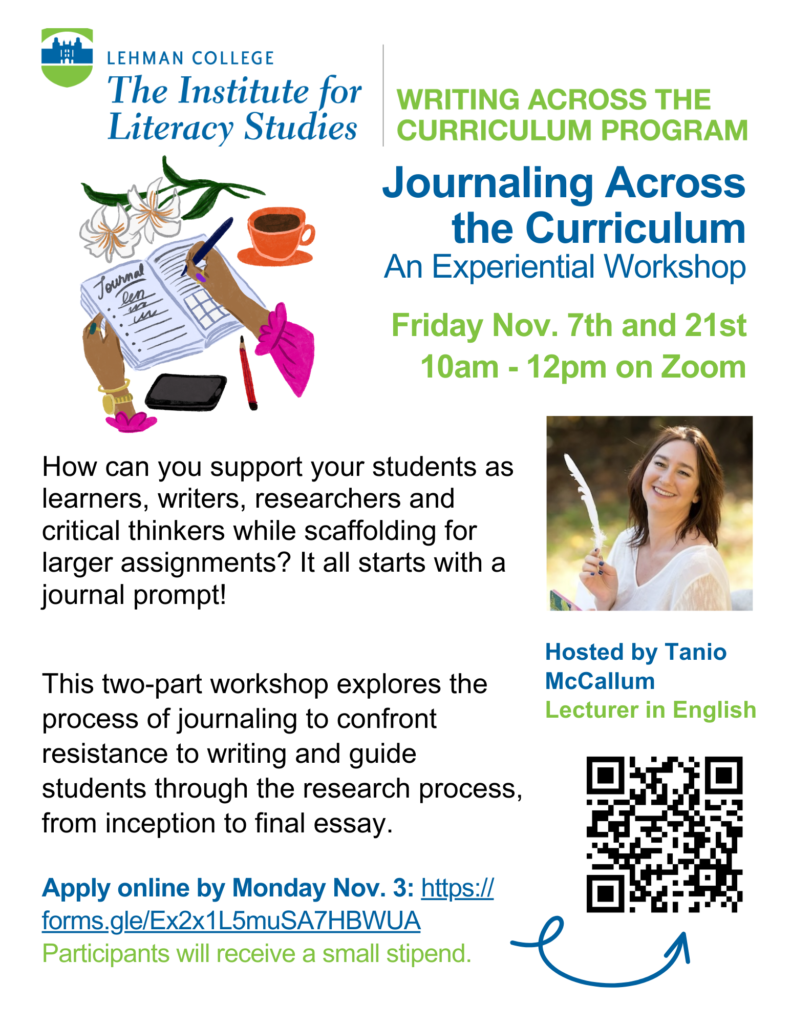
How can you support your students as learners, writers, researchers and critical thinkers while scaffolding for larger assignments? It all starts with a journal prompt!
This two-part workshop explores the process of journaling to confront resistance to writing and guide students through the research process, from inception to final essay.
Facilitated by Tanio McCallum.
2024-2025 Workshops
“Teaching Writing in the time of AI: Using ChatGPT Across the Disciplines” | Thursday April 3rd and 10th
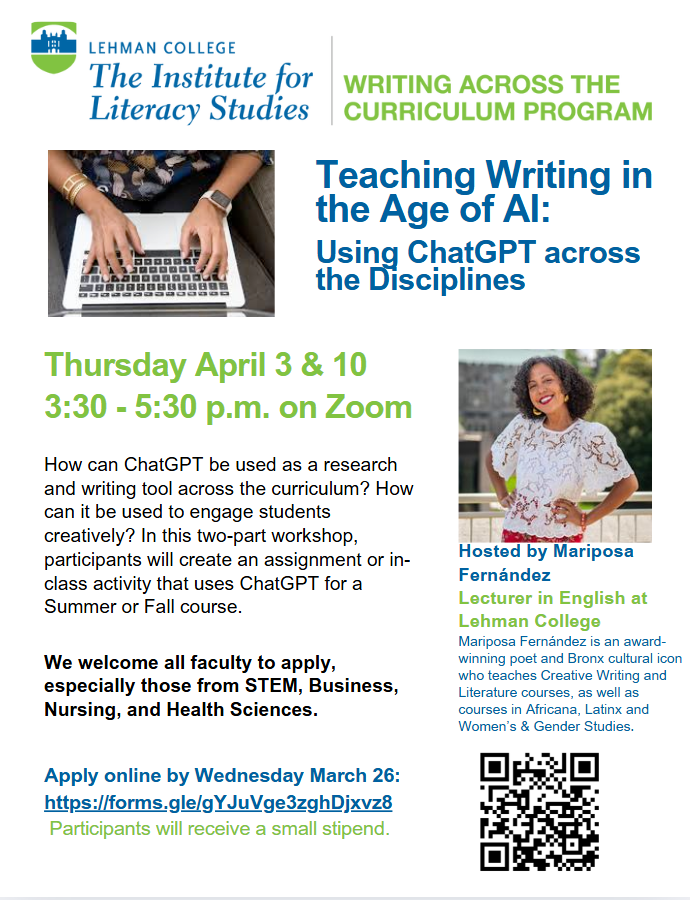
How can ChatGPT be used as a research and writing tool across the curriculum? How can it be used to engage students creatively? In this two-part workshop, participants will create an assignment or in-class activity that uses ChatGPT for a Summer or Fall course.
We welcome all faculty to apply, especially those from STEM, Business, Nursing, and Health Sciences.
Facilitated by Mariposa Fernandez.
“Cultivating Wonder and Delight: Renew Your Teaching Self!” | Friday February 28th and Friday March 7th
How can you get your students to be more engaged? How can you renew your teaching self? How can you infuse your classrooms with wonder and joy? In this two-part workshop, we will delve into playful interactive exercises that re-energize your classrooms.
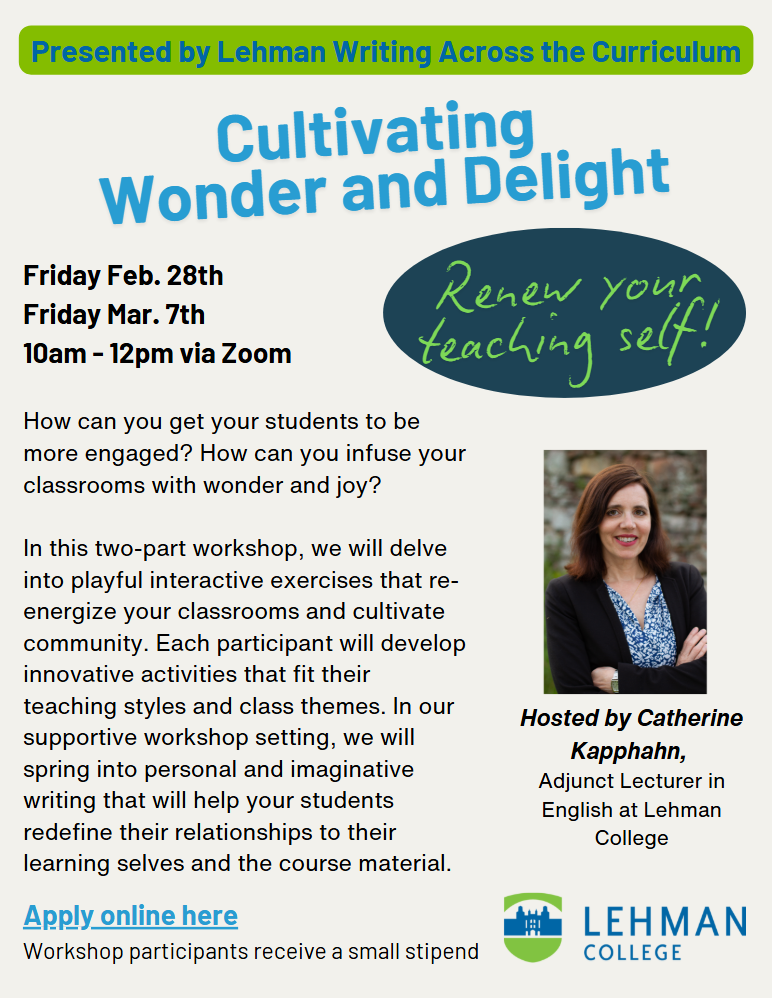
We will discuss ways to design energetic hands-on activities that cultivate community. Each participant will come up with innovative activities that fit their teaching styles and class themes. In our supportive workshop setting, we will spring into personal and imaginative writing that will help your students redefine their relationships to their learning selves and the course material. Join us on this exploration!
Facilitated by Catherine Kapphahn.
2023-2024 Workshops
“Teaching Writing in the time of AI” | Monday April 15th
A workshop about how AI could be used to help students write better and how we could use AI in writing across disciplines. Participants will:
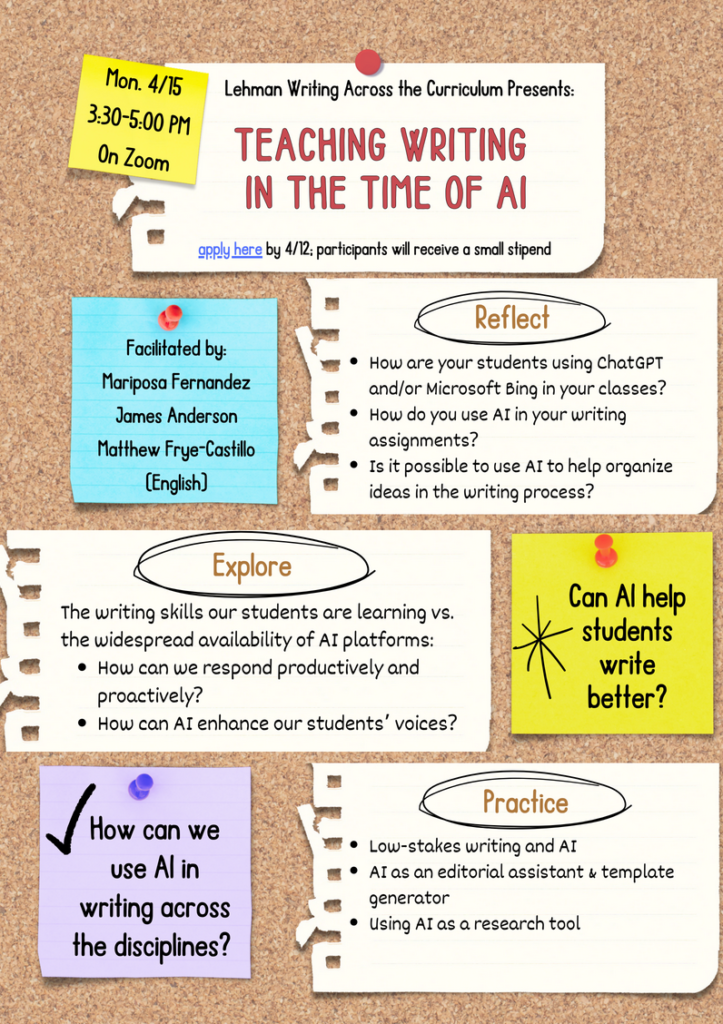
- Practice low-stakes writing and AI, AI as an editorial assistant & template generator and using AI as a research tool.
- Reflect on questions such as: How are your students using ChatGPT and/or Microsoft Bing in your classes? How do you use AI in your writing assignments? Is it possible to use AI to help organize ideas in the writing process?
- Explore the writing skills our students are learning vs. the widespread availability of AI platforms.
How can we respond productively and proactively? How can AI enhance our students’ voices? Facilitated by Mariposa Fernandez, James Anderson, and Matthew Frye-Castillo.
“Cultivating Wonder” | Friday April 19th
How can we get our students to fall in love with learning? How can our students build new relationships with their learning selves? This workshop will lead participants through collaborative and interactive exercises that will help them cultivate wonder in their classrooms.
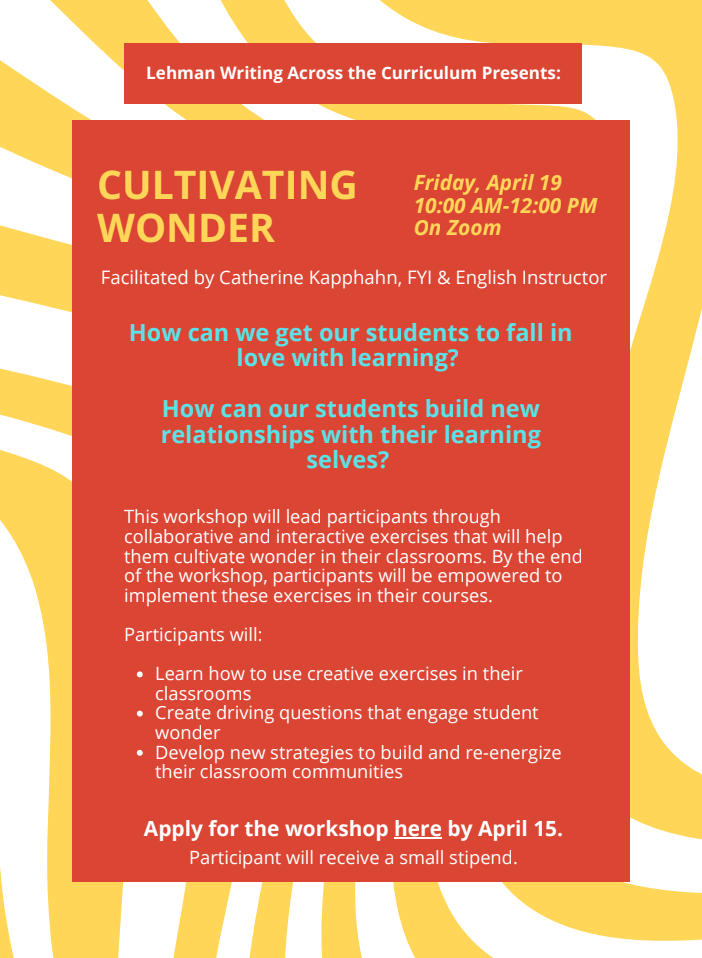
By the end of the workshop, participants will be empowered to implement these exercises in their courses. Participants will:
- Develop new strategies to build and re-energize their classroom communities
- Learn how to use creative exercises in their classrooms
- Create driving questions that engage student wonder
Facilitated by Catherine Kapphahn, FYI & English Instructor.
New Faculty WAC Workshop: How to Implement Anti-Racist Pedagogies at Lehman | Friday November 3rd
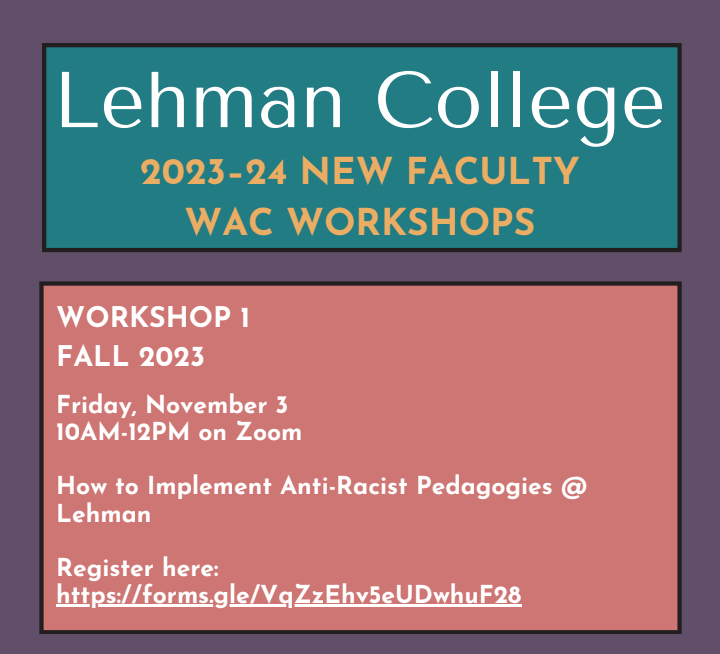
This workshop, facilitated by Sarah Ohmer and Sophia Hsu (WAC Coordinators), was organized in conjunction with the Provost’s Office to orient new Lehman faculty to the needs of Lehman students and to WAC principles.
2022-2023 Workshops
“Your Assignment Here: Anti-Racist Resources from WAC Fellows”
Lehman WAC’s 2022-23 PhD Fellows shared their approaches to teaching and assessing writing with an anti-racist praxis. Presentations below:
- Samuel Teeple (Music): As an instructor of an introductory course for non-majors (Music Appreciation, or Introduction to Music), I have created a variety of low-stakes writing prompts that, unlike the formal expectations of a written paper, give students space to process class concepts and apply them to their own life experiences. To break up the traditional lecture, I incorporate low-stakes writing prompts in most class sessions, with the goal of “writing to think”–instead of aligning their writing with the expectations of an outside reader, these prompts ask students to use writing as an extension of their thought process. Additionally, I assign short, informal blogs (200 words) with prompts that ask students to introduce their own favorite music in connection to the conversations and skills being used in our course. Though students are asked to produce written language, these prompts ask students to respond to or incorporate music and other media within their responses, a context which can be adapted to fit courses outside of music.
- Miriam Navas (Latin American and Iberian Literatures and Cultures): decolonizing the language and inclusion of historically excluded scholars for the Self-identification of students
- Eliana Peck (Philosophy): first experience with equitable grading/ungrading and several assignments that show these practices
- Talya Wolf (Sociology): Marrying affect with skill-building – A lesson plan and worksheet that helped students to design research questions that are specific, answerable, and most importantly, exciting to them. The worksheet helps students narrow their broad areas of interests to specific research questions and identify key words that will help them search academic databases effectively and efficiently. In this way, I hope to foster student joy and intrinsic motivation as well as to arm them with concrete tools for academic success.
- Matthew Timmerman (Music): teaching writing through public-facing genres like the op-ed; will share reasons for using the op-ed and how to scaffold the op-ed as a writing assignment in various writing classrooms
“What’s in a Grade? A Workshop on Alternative Grading Practices” | Friday March 17
This workshop engaged participants in a conversation about the role of grades in teaching and learning by discussing care-based approaches to grading that challenge and reimagine more traditional grading systems and the white supremacist assumptions underlying “good grades” and “poor performance.” Presenters shared examples of alternative grading (collective rubrics, labor contracts, practices of ungrading, etc.), and discussed with participants how alternative assessment could be implemented in their classes and assignments as well as the challenges it might pose to their disciplines. Attendees left the workshop with practical takeaways and meaningful reflections on assessment practices in their own assignment and course design, whether they decide to implement alternative grading in the future or not.
Facilitated by Sophia Hsu, English; Sarah Ohmer, Latin American & Africana Studies; and Austin Bailey, Graduate Center English.
Writing Across the Curriculum for New Faculty | Fall 2022-Spring 2023
A 4-session series co-facilitated with the Provost’s office and aimed at orienting new Lehman faculty, with presenters from School of Arts & Humanities, Natural Sciences and Social Sciences, CUNY Graduate Center, as well as Lehman undergraduate students.
- Session 1: Introduction to WAC Principles, Wednesday 11/9, facilitated by Sophia Hsu and Sarah Soanirina Ohmer
- Session 2: Compassion & Radical Care in Syllabus Design, Wednesday 12/7, facilitated by Vani Kannan and Vannesa Arcenti
- Session 3: Anti-Racist Grading Practices & Student-Teacher Affect, Wednesday 02/15, facilitated by Austin Bailey
- Session 4: Multimodality & Translanguaging, Wednesday 04/26, facilitated by Tailisha Gonzalez and Cecilia Espinosa
2021-2022 Workshops
Spring 2022 WAC Series. Writing Community Histories: A Workshop with the Bronx County Historical Society Archives. A 2-part Workshop (ZOOM & IN PERSON)
Facilitated by Vani Kannan (Assistant Professor of English) and Steven Payne (Archivist at Bronx County Historical Society)
Day 1: May 18, 2022, 3:30-5:30 (ZOOM): Introduction to the Archive’s Digital Collections
- How can archived Bronx histories ground our classrooms in local, national, and international currents of social justice organizing?
- How is local history tied to the work of anti-racist pedagogy?
- How can we both amplify the archive’s histories and potentially become part of them?
This workshop introduces faculty to the Bronx County Historical Society Archives, and offers a space to brainstorm public, multimodal writing assignments that draw from its holdings. Located at 3313 Bainbridge Avenue, the archive offers a rich resource of local social justice organizing. For example, it houses the papers of local Black feminist communist activist Angie Dickerson and the papers of the organization White Lightning (a group that worked with the Young Lords and Black Panthers in the Lincoln Hospital takeover). See, for example, Steven’s Social Justice Collections Research Guide. Participants will brainstorm ways to link their writing assignments to the project of writing community histories by engaging with Steven and Vani’s call for “Community Notes,” soon to be published on the archive’s website; peruse the archive’s digitized collections as well as various digital interactive tools and points of access; discuss the intersections of multimodality, public writing, and archival pedagogy; gain tools for incorporating digital archives into their classrooms; tour the Bronx County Historical Society Archives; develop activities with archived materials; receive syllabus/ assignment development support; receive concrete strategies for designing public student projects using the archive’s holdings; and reflect on possibilities for going public with their own writing, and/or contributing to the archive.
Day 2: May 25, 2022, 3:30-5:30 (IN PERSON): The Bronx County Historical Society Archives, 3313 Bainbridge Avenue, Bronx, NY.
The second workshop includes an archive tour, activities with archived materials, and syllabus/ assignment development support. Faculty will leave this workshop with concrete strategies for designing public student projects using the archive’s holdings, possibilities for going public with their own writing, and ideas for contributing to the archive.
Summer 2022 WAC Series. Life-Giving Practices Across the Curriculum: Learning from Audre Lorde and Ericka Huggins, A 3-part Workshop Series on ZOOM
Facilitated by Mary Phillips, Ph.D. and featuring Sunyata Smith, Ph.D.
June 10, 10am-1pm: Vulnerability & Compassion in Activist Scholarship & Writing Pedagogy
June 17, 10am-1pm with Dr. Sunyata Smith: Wellness Practices that Give Back in the Classroom and Beyond
June 24, 10am-1pm: Putting Wellness Practices into the Curriculum
- How do we be well and do our work?
- How do pleasure activism and Black joy shape your teaching and/or scholarship?
- How do we sustain activist scholarship and writing pedagogy during the pandemic?
In this Summer Series, participants will identify concrete needs for wellness in day-to-day environments, academic or otherwise, and practice self-reflective writing (in part with the goal of preparing to engage our students in these same practices); reflect on models of wellness practices in higher education, scholarship, teaching, and institutional environments; review resources to cultivate wellness practices; explore unique ways to make room for wellness work in the classroom; and set realistic and measurable goals to implement wellness over the summer and the following academic year.